
What is TipESM?
TipESM is a project funded by the European Union Horizon Europe Funding Programme. The project started on 1 January 2024 and will run until 31 December 2027.
TipESM is coordinated by the Danish Meteorological Institute with Dr. Shuting Yang (sy@dmi.dk) as the Project Coordinator.
What do we do?
TipESM brings together scientists from a range of disciplines to deliver a step change in our understanding of climate tipping points in the Earth system, including their impact on ecosystems and society, combined with a set of early warning indicators and safe future emission pathways that minimise the risk of exceeding such tipping points.
TipESM assembles the latest Earth System Models (ESMs), including recent improvements to key processes: ice sheets, vegetation and land use, permafrost, marine and terrestrial biogeochemistry. In cooperation with the WCRP/Future-Earth project TIPMIP, TipESM will organise an international collaboration to design and realise a common ESM experiment protocol that will facilitate analysis of the likelihood of occurrence, and potential reversibility, of tipping elements at different levels and duration of global warming. These experiments, will be combined with more project-specific ESM experiments, designed to investigate interactions and feedbacks across the Earth system.
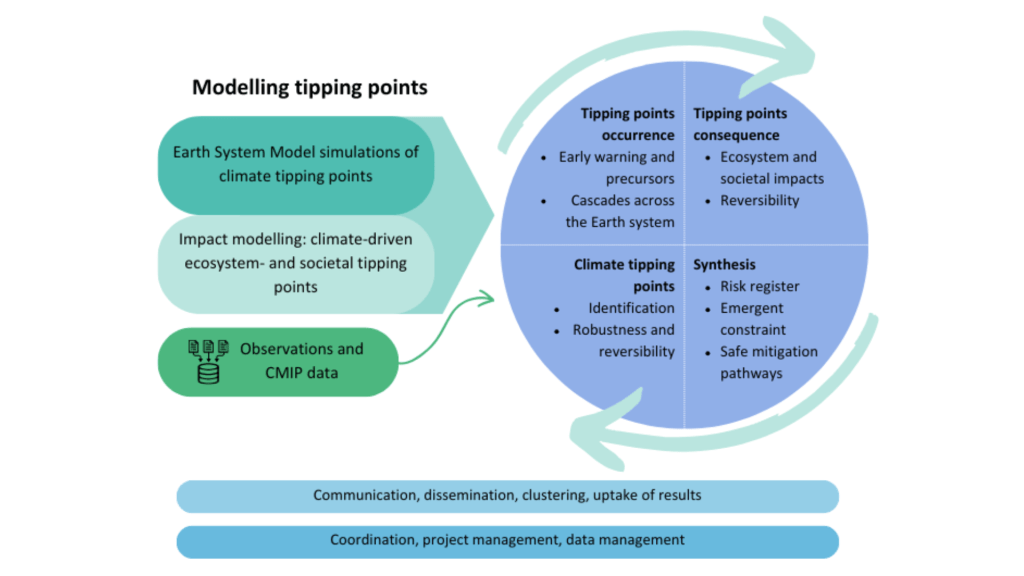
Based on the TipESM experiments, existing simulations and observations, we will investigate tipping points, their driving processes, potential early warning signals and cascading effects across the climate, ecosystems and society. Including the most important components of the Earth system in our ESMs will also allow TipESM to identify potentially unknown tipping elements, their precursors and impacts.
How do we work?
TipESM brings together expertise from climate science and climate impacts to investigate both the role of gradual climate change for tipping in individual ecosystems and society, and the impact of crossing specific climate tipping points for society, ecosystems, and biodiversity. Project findings will be synthesised into a tipping points risk register.
New knowledge and data from TipESM will be regularly communicated to a broad range of research communities, policymakers and the public, contributing to a prepared and resilient society.
See a diagram visualising our approach on the right side (DMI, CC BY 4.0).
Science Themes
TipESM is organised into a series of science themes implemented by the project Work Packages which set out achieve the primary objective of TipESM – to deliver a step change in our understanding of climate tipping points in the Earth system, including their impact on ecosystems and society, combined with a set of early warning indicators and safe emission pathways that minimise the risk of exceeding such tipping points.
Simulating Tipping Points in the Earth system with an ensemble of ESMs and dedicated experiments
1. To design and perform a set of coordinated experiments with coupled Earth system models to support the investigation of Earth system tipping points at different levels of global warming
Work Packages: 1, 2, 4 & 5
Delivering new knowledge on climate TPs and their driving processes
2. To identify climate tipping points in the CMIP6 archive and dedicated runs from TipESM and previous EU projects, and improve our understanding of the processes underpinning such tipping points and their impact across the Earth system
Work packages: 1 & 2
3. To investigate the robustness and potential (ir)reversibility of climate tipping points
Work packages: 1 & 3
Developing early warning indicators and assessing the risk for cascades of TPs across the Earth system
4. To identify precursors of climate and ecological tipping points, and develop reliable early warning indicators based on Earth system models and observations
Work packages: 1, 4, 5 & 6
5. To identify the risk of a cascade from one climate tipping event to others
Work packages: 1, 5, 6 & 7
Identifying climate-driven TPs in ecosystem and society
6. To identify tipping events in ecological and societal systems, with a focus on the climate-drivers of these events, emphasising biodiversity, human health and habitability
Work packages: 1, 3 & 6
Delivering new knowledge on the impacts of TPs on ecosystem and society
7. To provide new understanding on the climate, societal and ecosystem consequences of crossing climate thresholds and tipping points
Work packages: 1, 7 & 8
Constraining future TP risks and providing safe mitigation emission pathways
8. To deliver a risk register of future tipping points and a set of safe emission pathways to minimise the chance of crossing such tipping points through engagement with stakeholders and by feeding tailored information to adaptation strategies via ClimateAdapt and European Environmental Agency, European Climate and Health Observatory, ECDC, UN Office for Disaster Risk Reduction (UNDDR), UNEP
Work packages: 1, 2, 3, 4, 5, 6, 7, 8, 9 & 10
Supporting European climate policy
9. To provide policy guidance to the European Commission, IPCC, IPBES and the UNFCC Global Stocktake, on the likelihood and consequences of crossing climate tipping points and mitigation options to minimise the chance of such events
Work packages: 1, 2, 3, 4, 5, 6, 7, 8, 9 & 10
Expected Impacts
TipESM delivers a unique contribution to the climate research landscape through advancing our knowledge on the risk of climate Tipping Points and their potential impact on ecological systems and society.
- Advancing knowledge and solution in Earth system science, pathways to climate neutrality, climate change adaptation, climate services, social science for climate action and understanding of climate-ecosystem interactions
- Contribute substantially to key international assessments (Intergovernmental Panel on Climate Change, Intergovernmental Science-Policy Platform on Biodiversity and Ecosystem Services, European Environment Agency)
- Increasing the transparency, robustness, trustworthiness and practical usability of the knowledge base on climate and Earth system change for use by policymakers, practitioners, other stakeholders and citizens
- Strengthening the European Research Area with increased knowledge on the risks of crossing climate Tipping Points


 TipESM