
Meet Didier Swingedouw
Dr. Didier Swingedouw is a climate researcher with strong focus on the North Atlantic region. He co-leads TipESM’s work package on Early Warning Indicators of Tipping Points and plays a key role in the work on tipping points and their driving processes, robustness and (ir)reversibility of tipping points, and societal and ecosystem consequences of tipping points. In this Researcher in the Spotlight, Didier takes us through his journey into the project. He shares insights with us into why the work being undertaken in TipESM is so crucial, his motivation for being part of the project and the broader implications of this research.
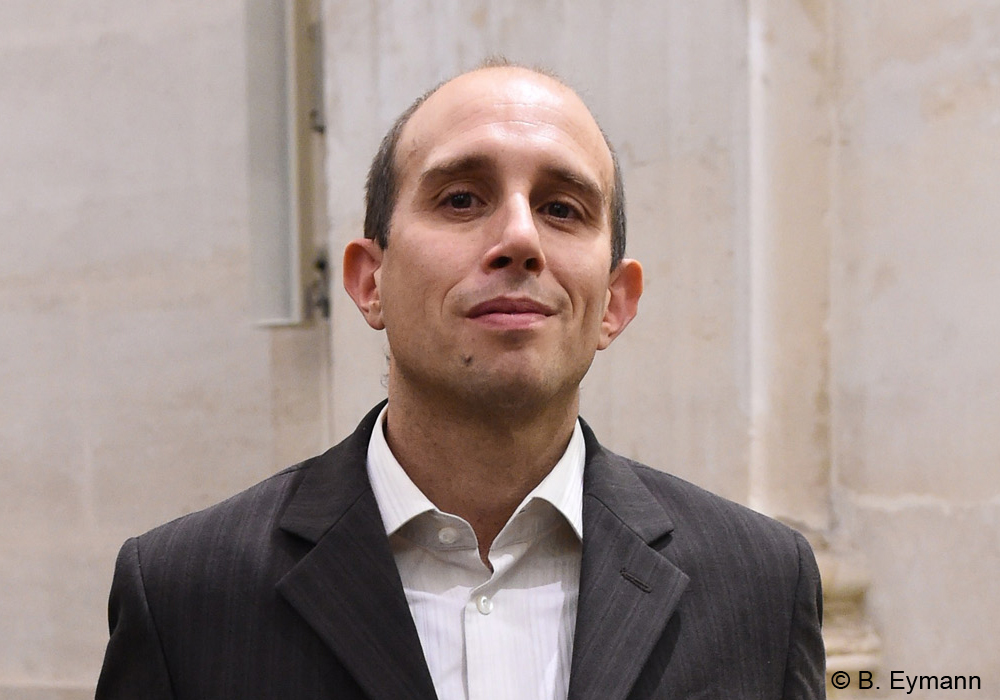
Please introduce yourself, Didier.
My name is Didier SWINGEDOUW, I am a researcher working on the dynamics of climate, with a particular interest for the North Atlantic region. I’m employed by the CNRS (French National Centre for Scientific Research, a multi-disciplinary institute) and I’m leading my research at University of Bordeaux.
Could you share some details about your professional and academic career before becoming part of the TipESM Community?
I have been in an engineering school in Paris that I chose because of its major in physical oceanography. From there, I started to learn about ocean and climate dynamics and became fascinated. This is why I decided to apply for a PhD at LSCE lab, located close to Paris, where Jean Jouzel, Valerie Masson-Delmotte and Robert Vautard, both former and present-day vice chair of IPCC WG, respectively, were working. My PhD thesis was about understanding of the main mechanisms at play in the response of the Atlantic Meridional Overturning Circulation (AMOC) to global warming. I mainly focused on the IPSL model behavior, and found an interesting bifurcation in the response of the AMOC, depending on the fact of accounting or not the Greenland ice sheet melting. I defended in 2006 and then moved for one year to Louvain-La-Neuve in Belgium, working on the other hemisphere and the response of the Southern Ocean to Antarctic ice sheet melting. Then, I spent two years in Toulouse, in the French MetOffice, where I studied climate variability over the last millennium. In 2009, I was hired by CNRS, back at LSCE, working on climate dynamics both in the paleo timescales, the present-day and the projections.
I like to try to build some bridges between different communities, and this is what I’m doing since then in my research, where I’m also very interested in societal impacts that might be triggered by on-going climate change.
This is notably why I’ve joined IPCC in 2016 as a lead author for the special report on the ocean and the cryosphere, published in 2019.
What motivated you or inspired you to become involved in TipESM?
The AMOC is well-known because of its non-linear behavior in response to external forcing. Given my interest on this phenomenon, I’ve been naturally attracted by the topic of tipping points. Within a European project named EMBRACE, I had the opportunity to dig further into this topic, with the help of Sybren Drijfhout and Giovanni Sgubin. By analysing CMIP5 archives, we found a number of rapid transitions in the subpolar gyre (SPG) of the North Atlantic. Those transitions were distinct and not well correlated with AMOC changes, and we proposed that they correspond to a specific tipping element, the SPG one, related with the AMOC but as a subpart, which can respond very rapidly, in about ten years, far faster than the AMOC response of a few centuries. This result leads me to learn more and more on the topic of tipping points, and I realize that our society is very poorly prepared to such events, since global warming is usually seen as a slow, though impactful, change in our climate conditions. In fact, it is not, and climate models are showing a wide range of different response to increasing greenhouse gases concentrations. Taking only the mean and a spread as usually done in IPCC reports as the best guess can be very misleading, and we are now at a moment where we need to go beyond this ensemble mean of model, and try to better understand and predict the risk of tipping points that can bring us quite far from the ensemble mean of climate models. This is what I am working on within TipESM, with a special focus on the North Atlantic region.
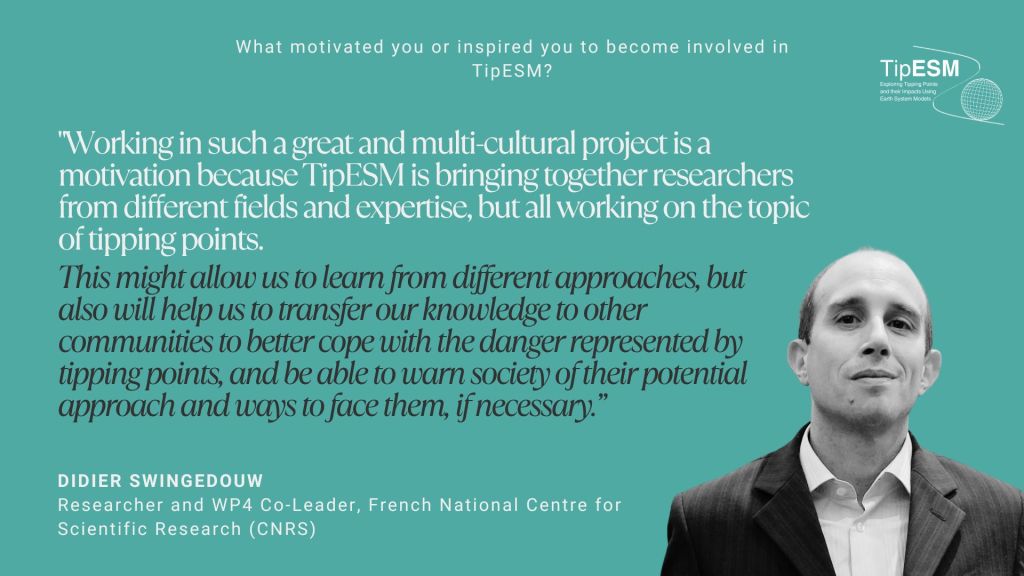
Working in such a great and multi-cultural project is a great motivation, because TipESM is bringing together researchers from different fields and expertise, but all working on the topic of tipping points. This might allow us to learn from different approaches, but also will help us to transfer our knowledge to other communities which might be able to help us to better cope with the danger represented by tipping points, and be able to warn our society of their potential approach and ways to face them, if necessary.
What do you do within TipESM?
I’m co-leading with Bo Christiansen the work package dedicated to establishing a better knowledge concerning our capabilities to warn in advance the approach of a tipping event, WP4: Early Warning Indicators of Tipping Points. For this, I’m working closely with WP2: Tipping Points and their Driving Processes and WP3: Robustness and (ir)reversibility of tipping points, to contribute and use the physical knowledge gained in those work packages into the development of our anticipation tools. I’m also heavily involved on the WP7: Societal and ecosystem consequences of tipping points, concerning the possibility of better estimating the risk of crossing a tipping point through the use of recent observations (a statistical approach named observational constraint). This is crucial given the variety of behaviors in terms of climate changes at the regional scale that can be found the different existing climate models.
What have you enjoyed about TipESM so far?
I really enjoyed the kick-off where the variety of actors and researchers participating to the project appears very clearly. Also, I really enjoyed working with a number of great experts in my topic of research to also brainstorm all together and challenge our ideas to improve them. This is a very motivating project, which will really bring our knowledge to a higher level, a key aspect to better anticipate our near future.
I also enjoy the cultural differences, and the different way of working and thinking, allowing us to keep the best of each culture for our research.
Looking ahead, what aspects or developments within TipESM are you most excited about?
I think there are two main things missing at the moment: the first one is a better understanding of the exact physical mechanisms in a number of tipping points. In this respect, the use of the latest models will be pivotal to progress on those issues, and also confront them with observations to estimate their realism and eventually reduce the uncertainty of their ensemble. The second main point is the lack of preparation our societies have concerning the way to cope with the occurrence of a tipping point. What if an SPG collapse occurs? What will the implications be for Europe in the next decade? I do not think the adaptation plans from different countries are really accounting for this. Such an event might strongly modify the seasonality of our European climate, and is very poorly accounted in the way we plan to adapt to climate change. The potential impacts on our society are possibly still unknown and we need to better reach the climate impact community to progress on this aspect. The development of meaningful storylines might be a crucial step in this respect. Furthermore, an AMOC substantial weakening might strongly affect West Africa, which migrations are already strongly pressing Europe. How will we handle the crisis that might come from millions of climate change refugees? We should start to have this more in mind when preparing for impacts of climate changes.
What makes our work in TipESM important? Why does it matter?
Given what I’ve just said, I think it is clear why it matters. Even though we are working on risk that will not necessarily appear, it is important to get correctly prepared. We’ve seen during the COVID crisis, that countries that were anticipating such a case a bit more seriously were the ones impacted less. Let’s allow Europe to be in this situation in case of such a climate crisis.
From your perspective, how do you foresee TipESM contributing to scientific progress in your field?
TipESM will certainly provide useful insights in the field of tipping points science, by bringing more mechanistic approach based on state-of-the climate models. Nevertheless, in research, this remains always difficult to foresee scientific progress. The nature of research is to make a few steps in the dark, so that it is not that easy to anticipate what might be the results in terms of progress.
In what ways do you believe TipESM will have an impact on society, either directly or indirectly?
I hope TipESM will help society to better incorporate the risk of tipping point in the way they foresee climate change, not only as a slow change where it is impacting us little by little. Rapid events can also occur and strongly affect us.
What advice would you offer to aspiring researchers who wish to pursue a similar career path?
My advice to researchers joining our project would be to keep a very rigorous scientific approach, and remain as objective as possible in the way they are facing new knowledge. We are leading urgent research because climate change is now accelerating, and the most harmful impacts are ahead, mainly related to tipping points either in climate or in society. Nevertheless, we should keep our mind clear and fresh and remain open to new ideas, new results and most precisely evaluating their robustness, using observations in particular. This is the way science is progressing, objectively, rigorously and patiently.
Anything else you would like to share?
No, that’s all folks.

 TipESM
Leave a comment