
TipESM Researcher in the Spotlight: Shuting Yang
Meet Shuting Yang
Dr. Shuting Yang serves as the Project Coordinator for TipESM and is a Senior Climate Scientist at the Danish Meteorological Institute. We had the opportunity to sit down with Shuting to dive into her background, discover what she’s looking forward to for TipESM, and explore her thoughts on how the project will contribute to both society and science.

Please introduce yourself, Shuting.
I am Shuting Yang and I work at DMI as a Senior Climate Scientist.
Could you share some details about your professional and academic career before becoming part of the TipESM Community?
Back in my career, I began my education in dynamical meteorology, which focused more on understanding the physics. Gradually, I shifted from a theoretical understanding to a broader comprehension of understanding the climate as part of the whole system. I then transitioned to simple atmospheric modelling and eventually to global Earth system modelling. I completed my bachelor and the master in China, and then I went on to pursue my PhD at Stockholm University.
What motivated you or inspired you to become involved in TipESM?
Climate models offer us a very good understanding of systems where observational data is lacking or incomplete. Models are also very good tools for exploring the climate on a long time scale. Given our expertise in climate modelling, we see this as a great opportunity to utilize this understanding to see how the climate may respond to different levels of anthropogenic forcings or states. This is what has motivated and brought together our community – the TipESM consortium – to collaborate and make a meaningful impact.
What do you do within TipESM?
Besides being the TipESM Project Coordinator, for myself, it is fascinating to use climate models to understand if there is risks for any sort of abrupt change, which is one way of defining tipping points, and under what conditions (or human induced forcings). We have a model capable of simulating the Earth system and I will use the model for such investigation. I am also eager to design some model simulations and to examine the simulation results!
What have you enjoyed about TipESM so far?
TipESM has provided me the opportunity to engage with many modelling groups, not only within the consortium, which comprises six Earth system models, but also beyond. TipESM has brought me to a stage where I have the opportunity to talk together with many more modelling groups and experts in tipping point studies to discuss what we can use the Earth system models for to make a step change in our understanding.
It is my first time as a coordinator, so there are many things that I am still learning, but I think that it is a really good opportunity for me to meet other scientists, other people in the field, to discuss with them at another level, not just having my fingers on the model, but more on how to design the model and model experiments and how to coordinate large research projects such as TipESM.
Looking ahead, what aspects or developments within TipESM are you most excited about?
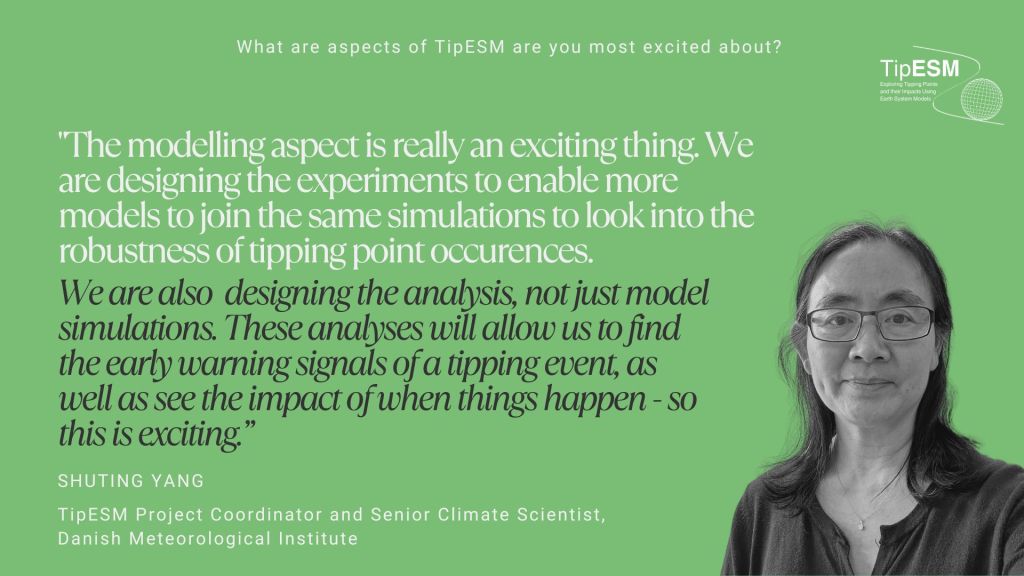
The modelling aspect is really an exciting thing. We are currently in the process of designing the experiments to enable more models to join the same simulations to look into the robustness of tipping point occurrences.
The current stage of designing a set of model experiments sets out to see if we can see things (tipping points) can happen, which help us to understand the conditions leading to tipping. However, we have also started the discussion of how to make it happen, to investigate the tipping mechanisms.
Also, in the project we will be designing the analysis, not just the model simulations. These analyses will allow us to find the early warning signals of a tipping event, as well as to see the impact of when things happen – so this is exciting.
From your perspective, how do you foresee TipESM contributing to scientific progress in your field?
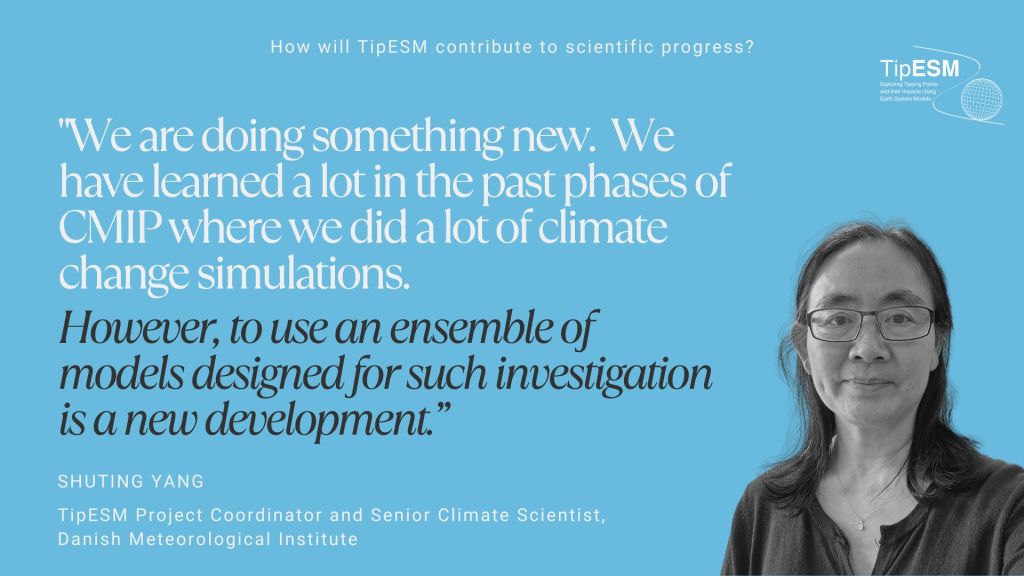
We are doing something new. We have learned a lot in the past phases of CMIP where we did a lot of climate change simulations. However, to use an ensemble of models designed for such investigation is a new development. We have moved ourselves to that stage where we are able to do this – to design experiments and look into the climate tipping points.
In what ways do you believe TipESM will have an impact on society, either directly or indirectly?
While we recognize that the model world differs from the real world, within the project, we have people who also look at observational data and try to understand what has already happened or what is happening. Our aspiration is that by using the model as a theoretical tool, we can understand more, such as why, when or to understand the physics and mechanisms behind these phenomena. With the model, we are also able to study the consequence and impacts if a tipping has happened.
We think that will be a real contribution to society. Rather than just merely speculating or engaging in abstract discussions, we aim to provide some physical background or baseline for us to have a more solid ground to say something about the phenomena.
What advice would you offer to aspiring researchers who wish to pursue a similar career path?
There are so many unknowns in climate science. I think that’s a positive thing for us scientists because curiosity is a driving force in our field. Working in this field, you won’t miss the enthusiasm or curiosity.
Then of course, it’s also important that you pursue whatever idea you may have. I think it’s important that you look to fulfill your curiosity, persevere, and pursue and work towards your goals.
Anything else you would like to share?
Let’s see what unfolds! I think TipESM is a really exciting project and there are many people involved in similar projects worldwide all seeking to understand tipping points. We are trying to explore ourselves and collaborate with those people and I think it will be an exciting time.



 TipESM